



There is a version of the AI-in-education conversation that I’m tired of. It usually opens with a slide of a robot at a whiteboard and ends with a vague promise that “this changes everything.” It rarely survives contact with a Sunday evening, a stack of mixed-ability classes, and a scheme of work that has to be ready by Monday morning.
I teach STEM to roughly 768 students across Years 4 to 9. I’m the only STEM teacher in my building. I know exactly what the workload feels like at the granular level — not the conference-keynote version, the real one. The lesson itself is the part I’d happily do for free. It’s the surrounding labour that quietly eats the week: writing the plan, then re-writing it for the students who’ll struggle, then building the quiz, then the rubric, then re-formatting all of it into whatever template the school requires this term.
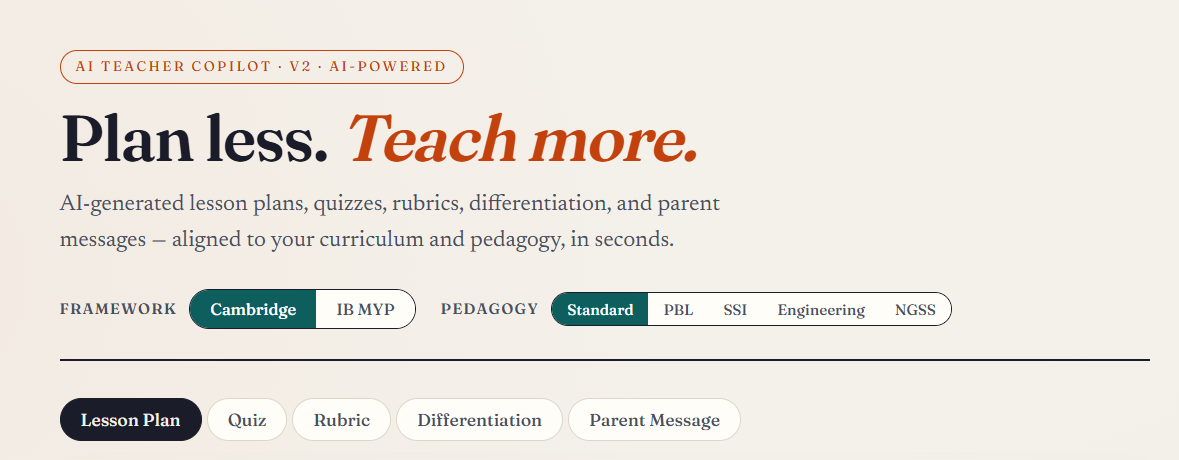
So I built the tool I wanted to exist. It’s called AI Teacher Copilot, and this post is a plain account of what it does and the thinking behind it.
You can try it here: ai-teacher-copilot-seven.vercel.app
The problem isn’t ideas — it’s the conversion of ideas into paperwork
Most experienced teachers are not short of ideas. Ask any decent practitioner what they’d do with a topic and they’ll talk fluently for ten minutes. The bottleneck is everything downstream of the idea: turning a good intention into a planned, differentiated, assessed, correctly-formatted artifact that satisfies both the students and the audit.
That conversion step is where hours disappear. And it’s precisely the kind of structured, repetitive, format-heavy work that a well-designed AI tool is genuinely good at — provided you keep the teacher’s judgment at the center and let the machine handle the production.
That distinction is the whole design philosophy. Copilot, not autopilot. The teacher decides what good looks like; the tool removes the friction between deciding and producing.
What it actually does
AI Teacher Copilot generates the core planning and assessment artifacts a teacher needs, from a short prompt about your topic, year group, and intent:
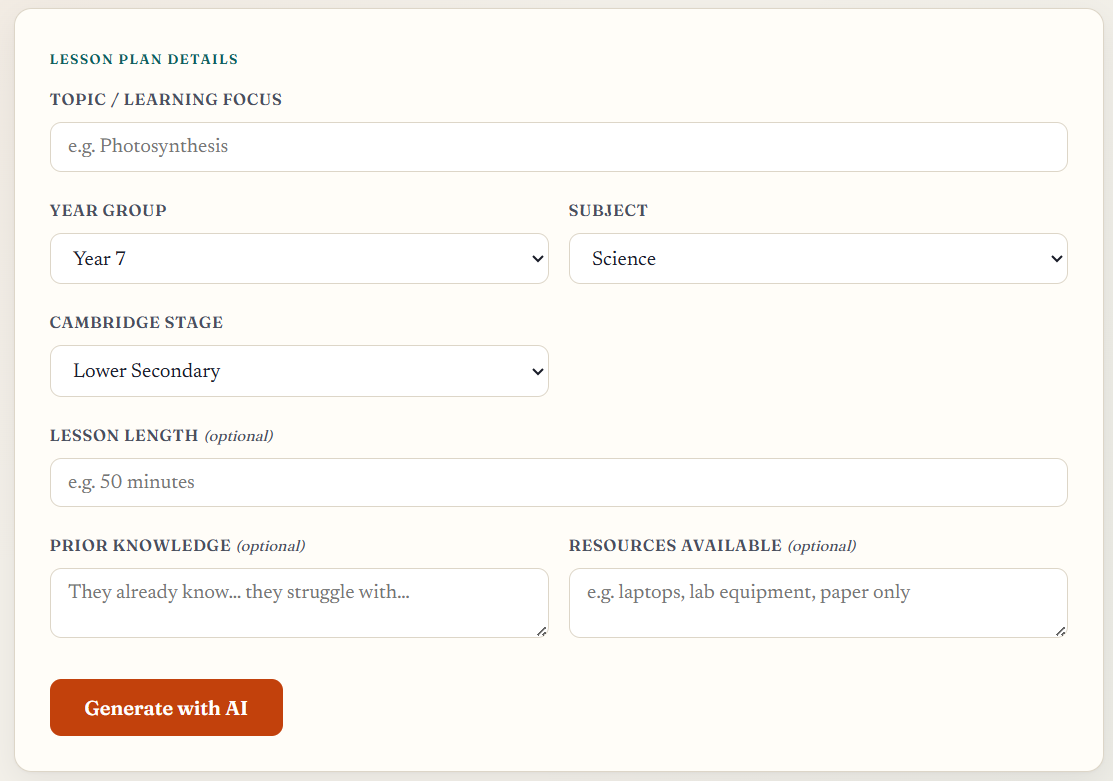
- Lesson plans structured around a coherent pedagogical flow rather than a generic bullet list.
- Quizzes and questions pitched at the level you specify, ready to drop into class or onto a worksheet.
- Rubrics that map to your success criteria so assessment is consistent and defensible.
- Differentiation plans — the part I personally needed most, because a single plan is never enough when you’re teaching the full ability range in one room.
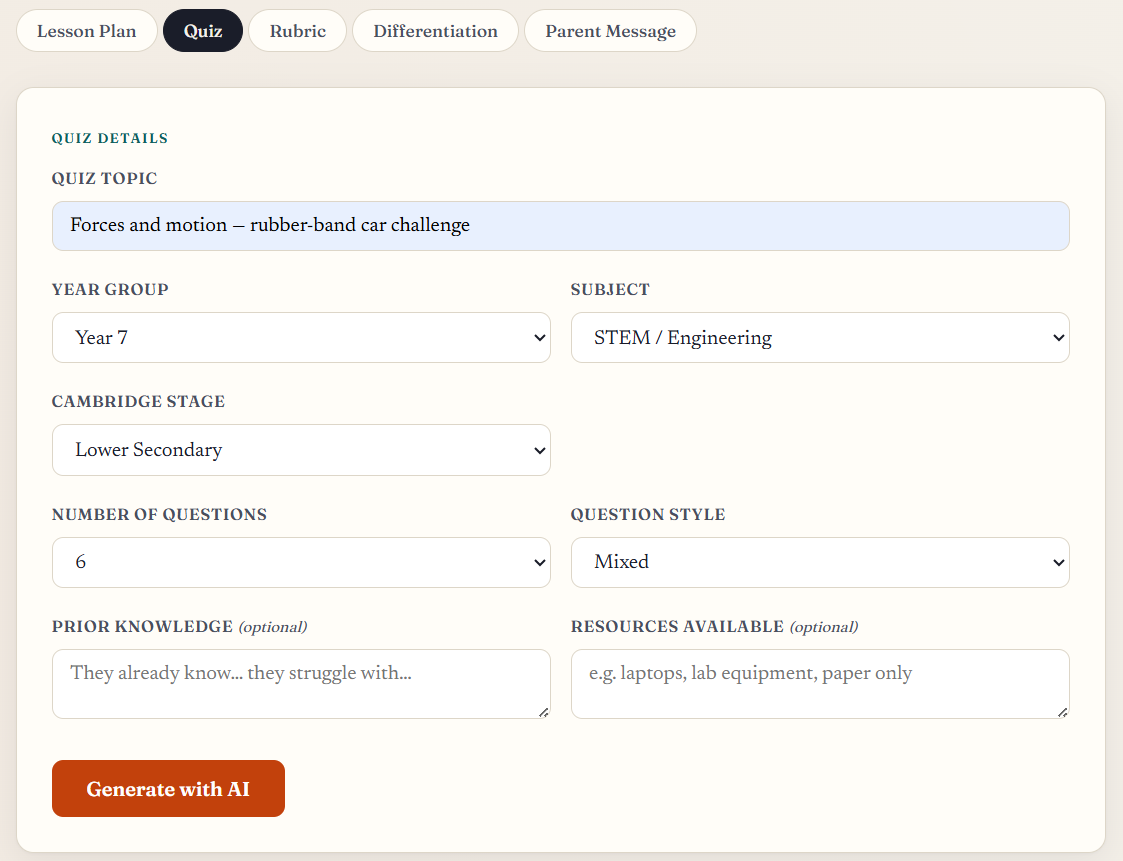
The point is not that these are impossible to write by hand. It’s that writing the fourth differentiated version of a plan at 9pm is a poor use of a trained teacher’s evening, and the output quality drops as the fatigue rises. The tool gives you a strong, structured first draft in seconds, and you spend your energy on the editorial judgment — sharpening, correcting, localizing — instead of on the blank page.
It speaks curriculum, not just “education”
Generic AI writing tools fail teachers in a specific way: they produce content that sounds educational but isn’t anchored to a framework. A plan that doesn’t map to your curriculum is extra work, not less, because now you have to retrofit it.
AI Teacher Copilot has framework toggles for the curricula I actually work in — Cambridge and MYP. That means the output is shaped to the assessment objectives and structures those frameworks expect, rather than a one-size-fits-nobody default. For a Cambridge Lower Secondary scheme it speaks Cambridge; for an MYP unit it respects the MYP logic. This is the difference between a tool that produces content and a tool that produces usable content.
The unglamorous feature I’m proudest of
Every school has a template. Yours probably has several, and they probably change. A huge amount of teacher admin is not intellectual work at all — it’s copying good content into the institutionally-required box, with the right headers in the right places.
Copilot includes a school template-filler: it takes the planning content and pours it into your school’s required document format. It’s the least glamorous feature in the product and, I suspect, the one that will save the most hours, because it attacks pure formatting labour — the work that has zero pedagogical value but is non-negotiable for compliance. Reclaiming that time is reclaiming time you can spend on students or on rest, both of which are in short supply.
A note on how it was built
I’m a teacher, not a software engineer by training. I built and deployed AI Teacher Copilot myself using GitHub, Vercel, and the Anthropic API. I mention this not to brag about the stack but to make a point I care about: the people closest to a problem are now able to build the tools that solve it. The barrier between “a teacher who knows exactly what’s broken” and “a working product that fixes it” has collapsed.
That has implications well beyond my one tool. The most useful EdTech of the next few years won’t necessarily come from large companies guessing at what classrooms need. Some of it will come from practitioners who got tired of waiting and built it themselves. I’d encourage more teachers to treat that as a real option.
Who it’s for, and what it isn’t
This is for working teachers — particularly those in Cambridge and MYP settings, and anyone carrying a heavy planning and differentiation load. It’s built to be a force multiplier for your professional judgment, not a substitute for it. It will not know your specific students, your room, or the particular kid who needs a different example to make the concept land. That’s your job, and it should stay your job. What the tool does is clear the runway so you have the time and energy to do it well.
I use it in my own week. It’s not a demo I dreamed up; it’s part of how I get through the volume without sacrificing quality or my evenings.
If you teach, try it and tell me where it falls short — I’m still building.
Try AI Teacher Copilot: ai-teacher-copilot-seven.vercel.app
Dickens Odhiambo Okoth is a STEM educator in Doha and the founder of STEMandFitness.com, where he writes about the intersection of education, technology, and disciplined high performance.