



In today’s rapidly evolving world, Science, Technology, Engineering, and Mathematics (STEM) sit at the heart of innovation, economic growth, and problem-solving. As societies transition into Industry 4.0 and respond to global challenges such as sustainability and climate change, STEM education is no longer optional; it is essential.
Yet, despite its importance, creating authentic, impactful STEM experiences in classrooms remains complex.
At stemandfitness.com, we believe that a healthy STEM ecosystem goes beyond curriculum and technology. It must also address teacher capacity, student equity, well-being, and real-world relevance. Below, we explore the key challenges facing STEM education today and the solutions that can help prepare a future-ready generation.
1. Empowering the Educator: Beyond Content Knowledge
The Challenge
Many teachers feel underprepared to deliver effective STEM instruction, not because they lack passion, but due to limited pedagogical support, insufficient professional development (PD), and rigid subject silos. This is often compounded by teacher burnout, especially in STEM, where planning demands are high and technological change is constant.
The Solution
-
Sustained Mentorship
Pairing early-career teachers with experienced STEM mentors builds confidence, supports classroom experimentation, and accelerates professional growth. -
Interdisciplinary Professional Development
PD must move beyond single-subject workshops to focus on integrated STEM, emerging technologies (including AI), and real classroom applications. -
A Culture of Iteration
Shifting toward a fail-forward mindset allows educators to model curiosity and resilience, key skills students need in STEM fields.
2. Breaking the Silos: Rethinking Curriculum Design
The Challenge
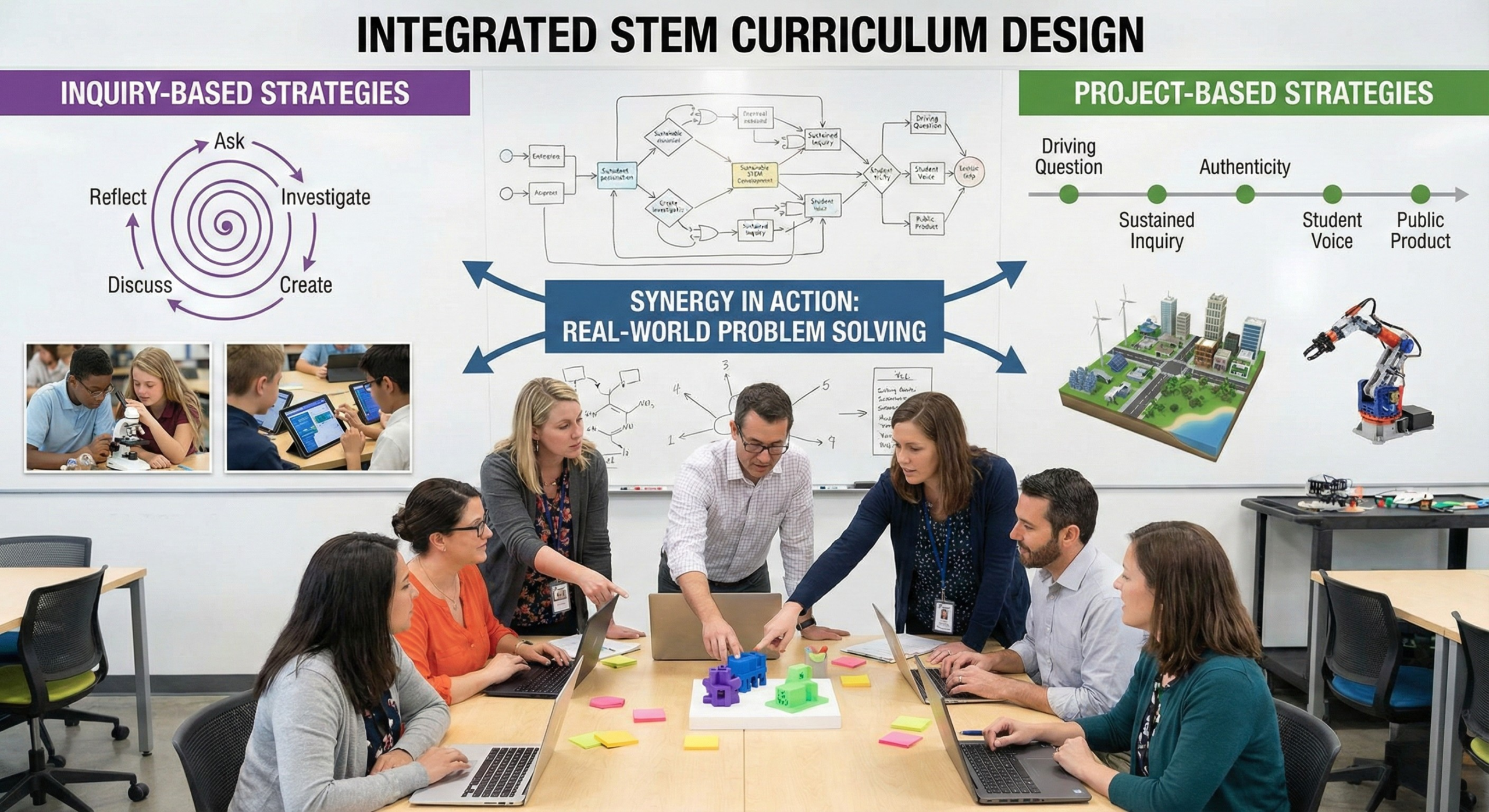
Traditional schooling often treats science, math, and technology as isolated subjects. Rigid schedules and test-driven instruction leave little room for hands-on, project-based learning, making STEM feel abstract and disconnected from real life.
The Solution
-
Inquiry-Based Frameworks
Models such as the 5E Instructional Model (Engage, Explore, Explain, Elaborate, Evaluate) and ADDIE transform lessons into authentic investigations rather than passive content delivery. -
STEM-DTaM (Design Thinking & Makerspaces)
STEM with Design Thinking and Makerspaces allows students to ideate, prototype, test, and refine, mirroring how real engineers and scientists work. -
STEM–TVET Integration
In technical and vocational settings, combining STEM with TVET strengthens employability by merging technical skills with analytical thinking and problem-solving.
3. Bridging the Gaps: Equity and the “MENA Paradox”
The Challenge
Equity remains one of the most pressing issues in STEM education. In the Middle East and North Africa, the so-called “MENA Paradox” persists: while women make up 34–57% of STEM graduates, they represent only about 19% of the STEM workforce.
Contributing factors include societal expectations, limited access to industry placements, and a lack of visible role models.
The Solution
-
Promoting Diverse Role Models
Showcasing leaders from diverse genders, cultures, and backgrounds helps students see STEM as a space where they belong. -
Flexible Learning and Work Models
Virtual labs and remote work models reduce physical and cultural barriers to participation. -
Safe Spaces for Innovation
Schools must intentionally create environments where marginalized students feel safe to explore, fail, and grow in STEM contexts.
4. Aligning Education with the Labor Market
The Challenge
A widening skills gap continues to undermine graduate employability. Across the region, an estimated 70% of the workforce lacks essential competencies, leading to a mismatch between academic qualifications and real-world job requirements.
The Solution
-
A Skills-First Approach
Emphasizing demonstrated skills, through digital badges and micro-credentials, over degrees alone ensures learners are job-ready. -
National Qualifications Frameworks (NQF)
Structured systems, such as Qatar’s NQF, align academic and vocational pathways with international labor standards. -
Public-Private Partnerships (PPP)
Collaboration between schools, universities, and industry creates apprenticeships and internships that keep learning relevant and current.
A Simple Analogy That Says It All
Teaching STEM without these solutions is like training for a marathon by only reading about running. You might understand the theory, but you won’t build the strength, endurance, or confidence to finish the race.
By integrating hands-on learning, interdisciplinary models, and industry partnerships, we give learners both the track and the coaching they need to truly hit their stride.
Final Thought
The future of STEM education is not about adding more content; it’s about designing better learning ecosystems. When educators are supported, curricula are integrated, equity is prioritized, and learning aligns with real-world needs, STEM becomes what it was always meant to be: a pathway to opportunity, innovation, and impact.