



Introduction: Movement as a Cognitive Accelerator
In STEM education and engineering practice, problem-solving is often framed as a purely intellectual endeavor. However, neuroscience is increasingly clear: the brain does not think in isolation from the body. Physical activity triggers biochemical and structural brain changes that directly enhance the cognitive functions required for mathematical reasoning, engineering design, computational thinking, and scientific inquiry.
This article moves beyond generic claims that “exercise is good for the brain” and dives into how specific physiological mechanisms enhance high-level STEM cognition.
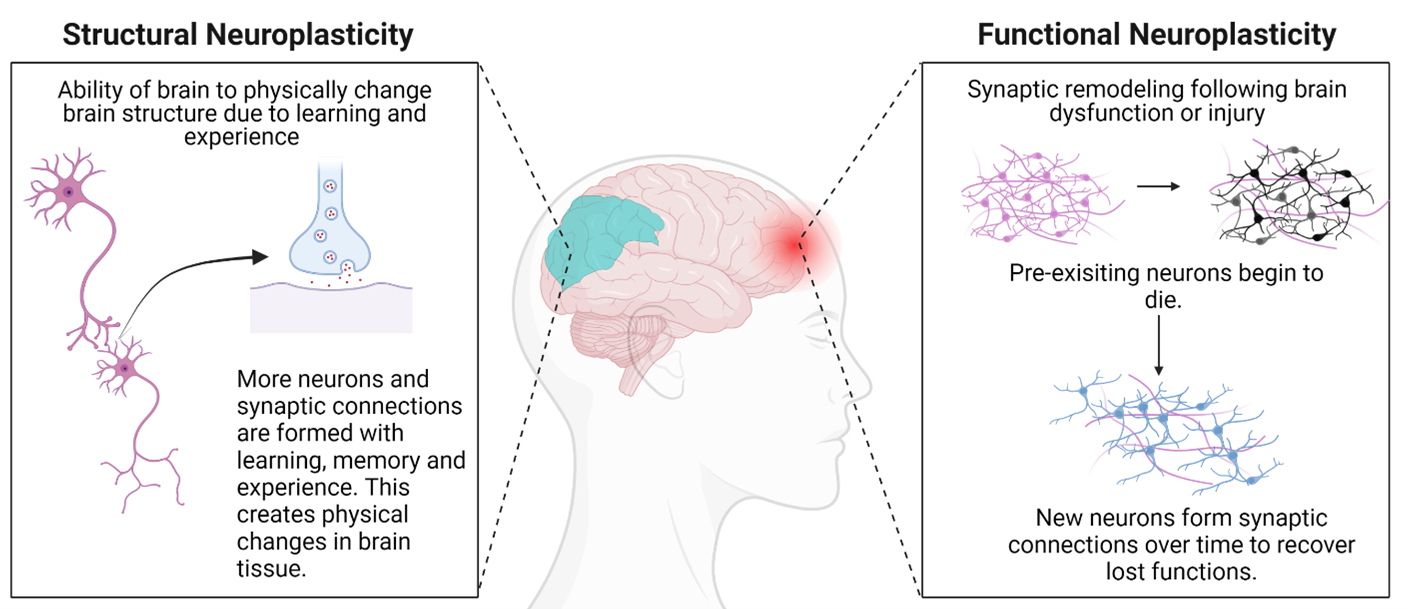
Figure 1. Neuroplasticity is popularly categorized into two categories: structural and functional. Structural neuroplasticity refers to physical brain tissue remodeling in response to learning and new experiences whereas functional neuroplasticity occurs when existing neurons propagate and form new synaptic connections after functional loss following injury. Image created with Biorender.com.
1. Brain-Derived Neurotrophic Factor (BDNF): Fuel for Learning and Abstraction
What is BDNF?
Brain-Derived Neurotrophic Factor (BDNF) is a protein that supports neurogenesis, synaptic plasticity, and long-term potentiation (LTP)—the biological basis of learning.
Why BDNF matters for STEM cognition
Complex STEM tasks—such as modeling systems, designing experiments, or solving multistep equations—require pattern recognition, abstraction, and long-term memory integration. BDNF enhances:
-
Synaptic connectivity in the hippocampus (critical for learning sequences and concepts)
-
Cortical plasticity (needed for transferring knowledge across domains)
-
Memory consolidation (essential for building mathematical frameworks)
Exercise effect
Aerobic exercise (running, cycling, brisk walking) significantly increases BDNF levels, sometimes doubling baseline concentrations after moderate intensity activity.
Implication for STEM learners: A student who exercises before a problem-solving session may literally have a more plastic brain capable of forming new conceptual links.
2. Dopamine: The Neurochemical of Engineering Creativity
Dopamine’s cognitive role
Dopamine is often labeled the “reward” neurotransmitter, but in STEM cognition it plays a deeper role in:
-
Cognitive flexibility
-
Working memory
-
Exploratory problem-solving
-
Innovation and creative hypothesis generation
Engineering design requires iterative trial-and-error, where dopamine helps the brain stay engaged through uncertainty.
Exercise effect
Physical activity increases dopamine synthesis and receptor sensitivity, particularly in the prefrontal cortex and basal ganglia.
Implication for STEM tasks: Exercise primes the brain to explore solution spaces rather than fixating on a single approach—critical for debugging code, optimizing models, or designing prototypes.
3. Prefrontal Cortex Activation: Executive Function and Mathematical Reasoning
Executive functions required in STEM
High-level STEM tasks demand:
-
Planning
-
Inhibition of irrelevant information
-
Multistep logical sequencing
-
Error monitoring
These functions are governed by the prefrontal cortex (PFC).
Exercise effect
Moderate-intensity physical activity increases cerebral blood flow and oxygenation to the PFC, improving:
-
Working memory capacity
-
Attention control
-
Task switching
-
Analytical reasoning speed
Implication: Students and professionals who move before tackling calculus proofs, coding algorithms, or experimental design tasks demonstrate sharper executive control.
4. Neurovascular Coupling: Oxygen, Glucose, and Cognitive Performance
The brain consumes ~20% of the body’s energy despite being ~2% of body mass.
Exercise improves:
-
Capillary density in brain tissue
-
Mitochondrial efficiency in neurons
-
Glucose transport to cognitive centers
This neurovascular coupling ensures that during intense thinking, the brain has sufficient metabolic fuel.
Implication: Physical inactivity is not just a health issue—it is a cognitive bottleneck.
5. Stress Hormones and Cognitive Load Management
Cortisol and STEM cognition
Chronic stress impairs hippocampal function and working memory—both essential for scientific reasoning and mathematical modeling.
Exercise effect
Regular physical activity:
-
Reduces baseline cortisol
-
Improves stress resilience
-
Enhances cognitive endurance during long problem-solving sessions
Implication: Fitness is a form of cognitive armor for high-stakes STEM environments.
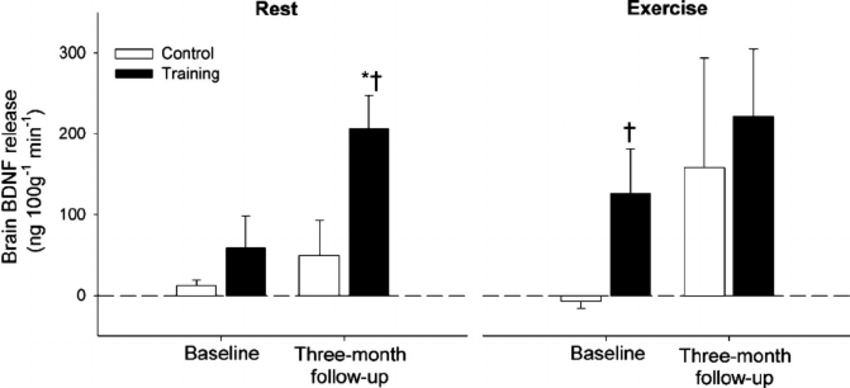
Figure 2. Brain-derived neurotrophic factor (BDNF) release at rest and during exercise in trained and control groups. Adapted from Rasmussen et al. (2009).
6. Embodied Cognition: Why the Body Shapes Thought
Emerging research in embodied cognition shows that movement influences how concepts are mentally represented.
For example:
-
Spatial reasoning improves after movement tasks
-
Gesture and physical manipulation enhance mathematical understanding
-
Kinesthetic learning strengthens engineering intuition
This suggests that STEM thinking is fundamentally embodied, not purely symbolic.
Practical Implications for STEM Education and Engineering Practice
For Students
-
10–20 minutes of moderate aerobic activity before studying improves conceptual learning
-
Light movement breaks during problem-solving sessions enhance working memory and creativity
For Educators
-
Integrate movement-based STEM tasks (e.g., measuring heart rate, physics of motion, biomechanics experiments)
-
Schedule practical STEM assessments after active sessions, not sedentary lectures
For STEM Professionals
-
Short exercise bouts before design meetings or coding sessions can increase innovation output
-
Walking problem-solving sessions (walking meetings) improve creative ideation
Conclusion: Fitness as Cognitive Infrastructure for STEM
Physical activity is not an extracurricular add-on to STEM learning.
It is a biological infrastructure for high-level cognition.
BDNF builds neural networks.
Dopamine fuels innovation.
Prefrontal oxygenation sharpens reasoning.
Stress modulation sustains intellectual endurance.
In the era of AI, robotics, and complex systems engineering, the future of STEM performance is not only computational—it is physiological.
The next frontier of STEM excellence is the integration of mind and muscle.